WHAT DO WE TEACH?

As children come to learn more and more about how music is put together, they will begin to have new ears to hear any music. They add critical thinking skills to their musical experiences and will enjoy many kinds of music. They also come to understand and love music as they have hands on experiences creating their own music. They can have that experience through private lessons or by just doing some of the fun lessons that I will share.

The lessons will center on the Elements of Music: Beat, Rhythm, Style, Melody, Expression, Form, Timbre, Harmony, and Texture. You can watch as children become confidant at discussing these elements and hearing them in the music they listen to each day. They will enjoy using these elements to create their own music.
Showing posts with label Upward and Downward. Show all posts

Monday, March 11, 2013

Lesson 1 Melodies Move Up and Down

Early experiences with melodies moving upward and downward can be really fun for young children because you can introduce instruments and integrate movement into these types of activities.

Here is a favorite that just simply teaches that music can move upward and downward.  It is on old children's song called The Bear Went Over the Mountain.  If you don't know the song you can find a lot of versions on YouTube.  I like this one the best because the video shows the bear going up and then the bear going down.  That is exactly what we are teaching today.

https://www.youtube.com/watch?v=CHfkcGSlRcA

Now that you know the song here is the arrangement I did with my kids.  We sang the song and then we walked up the mountain on our instruments and then sang the second part and walked down the mountain.  We used small xylophones and turned them sideways so as we played we were actually going upward and downward on the instrument.  If you use a piano you have to explain that upward moves from low to high and downward moves from high to low. With bar type of instruments it helps to remember that large is low and small is high.  So the kids can organize bells from low to high.  It you want to play around with the water glasses use glasses that are all the same and help the children to see that the amount of water changes the pitches from low to high.

See below for other ways to create melody instruments if you do not own one that the children can play.
Creating Melody Instruments:  Check out these sites:

WATER GLASSES: This site has instructions for creating a "xylophone" out of glasses filled with water.  This would be fun to do and I wouldn't worry at all about creating the perfect scale.  The point to the lesson would be that you are creating a set of pitches that go from low to high. 
http://www.storytimesongs.com/instruments.html

MAKE A SET OF TUBULAR BELLS
http://www.sugardoodle.net/joomla/index.php?option=com_content&task=view&id=3287&Itemid=5

HERE IS A SET OF TUBULAR BELLS PUT TOGETHER AS A XYLOPHONE
http://www.motherearthnews.com/do-it-yourself/homemade-xylophone-zmaz81ndzraw.aspx#axzz2NEArGVwd

Here is a easy way to put your bells together as a xylophone:
http://www.youtube.com/watch?v=ZjAXR-jwviM


Lesson 2 Melodies Move Up and Down

Ebeneezer Sneezer, a Simple C Scale Song

Here is a simple scale song that can be used with Boomwhackers®.
  (C) Ebeneezer Sneezer
  (D) topsy turvy man
  (E) walks upon his elbows
  (F) anytime he can
  (G) dresses up in paper
  (A) everytime it pours
  (B) whistles Yankee Doodle
  (C') everytime he snores
  (C' B A G F E D C) Oh  Ebeneezer what a man! (fast descending scale)

Here is a video where you can learn to sing this very simple song. She is playing it on the piano at the same time so if you have a piano you will be able to quickly be able to both play and sing the song.

http://www.youtube.com/watch?v=MMXEQ-S65QM


This is a good sing-a-long version that is much more fun for singing.
http://www.schooltube.com/video/50a12eaffb21e4f03b3e/Ebeneezer%20Sneezer

You will notice that it says it is color codes for boomwhackers.  Boomwhackers are incredibly fun instruments that are made of colorful tubes.  For $20 you can buy the basic set and play this song and lots of other songs.

http://www.musiciansfriend.com/classroom-kids/boomwhackers-c-major-diatonic-scale-set-upper-octave-boomwhackers-tuned-percussion-tubes

Another option is an 8 note glockenspiel.  Here is one at Amazon for $13.99. 
http://www.amazon.com/Eight-Note-Glockenspiel-Two-Mallets/dp/B0002E362S

The advantage of the glockenspiel is that a child can play the song easily by themselves whereas boomwhackers were more designed for a group to play, each one playing one note.

Lessons 3 Melodies Move Up and Down

If you purchased the glockenspiels or boomwhackers or if you have a piano, you can find lots of  additional songs to play on the 8 note scale.  Every melody moves upward and downward so playing any of these helps the children to see this concept.

Songs that you already know are easy to play because you know the rhythm and speed of the notes from singing the songs so you just need to know which notes to play.  You can adapt these for the xylophones, piano, boomwhackers, etc. Since the C scale has a low C and also a high C, the low C is written simply as C while the high C becomes C'.

To play "Mary Had a Little Lamb" do the following:
  1. Begin with your mallet on E.
  2. Play the following note progression: E-D-C-D-E-E-E, D-D-D, E-G-G, E-D-C-D-E-E-E-E-D-D-E-D-C.
To play "Three Blind Mice" do the following:
  1. Begin with your mallet on E.
  2. Play the following note progression: E-D-C, E-D-C, G-F-F-E, G-F-F-E, G-C'-C'-B-A-B-C'-G-G, G-C'-C'-C'-B-A-B-C'-G-G, G-G-C'-C'-B-A-B-'C-G-G-G, F-E-D-C
To play "Twinkle Twinkle Little Star" do the following:

     1.  Begin with your mallet on low C.
     2.  Play the following note progression:  C-C-G-G-A-A-G, F-F-E-E-D-D-C, G-G-F-F-E-E-D, G-G-F-F-E-E-D, C-C-G-G-A-A-G, F-F-E-E-D-D-C

To play "Row, Row, Row Your Boat" do the following:

    1.  Begin with your mallet on low C.
    2.  Play the following note progression:  C-C-C-D-E, E-D-E-F-G, C'-C'-C'-G-G-G-E-E-E-C-C-C, G-F-E-D-C

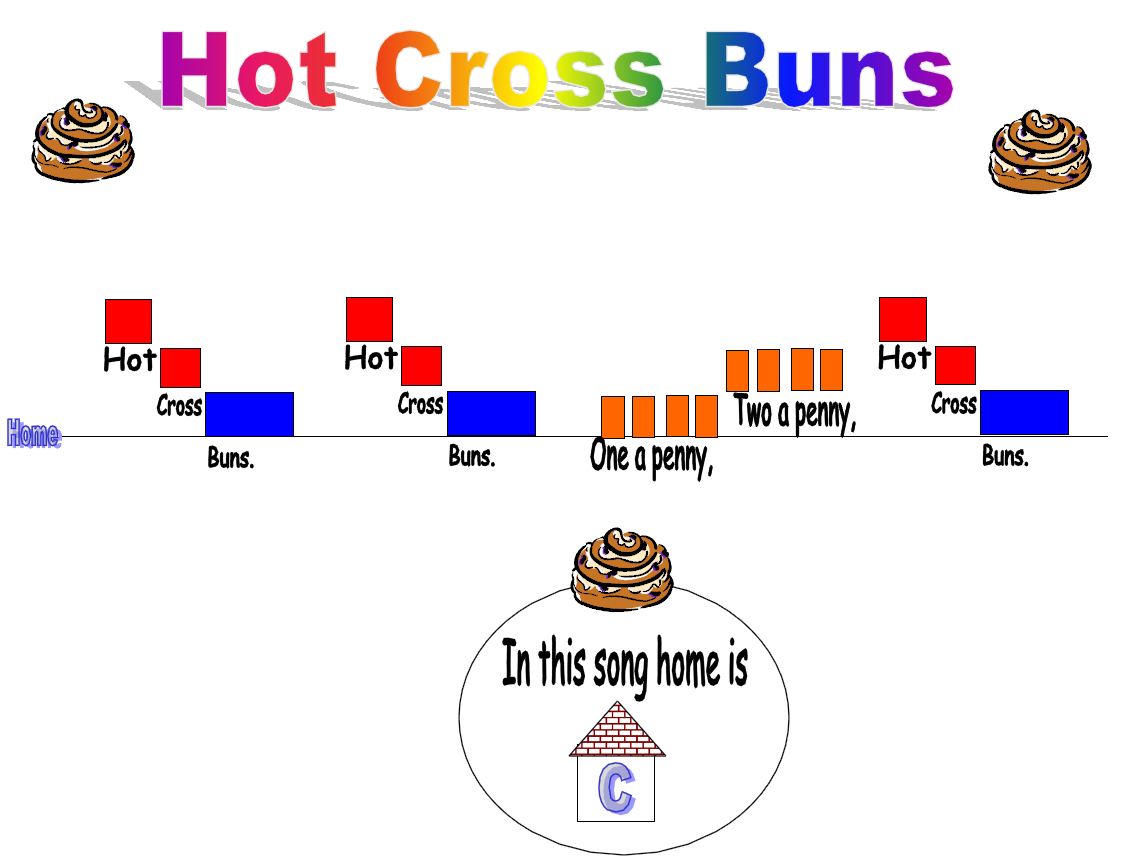
To play "Hot Cross Buns" do the following:

    1.  Begin with your mallet on E.
    2.  Play the following note progression: E-D-C, E-D-C, C-C-C-C-D-D-D-D, E-D-C

To play "London Bridge" do the following:

    1.  Begin with your mallet on G.
    2.  Play the following note progression: G-A-G-F-E-F-G, D-E-F, E-F-G,G-A-G-F-E-F-G, D-G-E-C


FYI:  This website has some Christmas songs for 8 notes:
http://www.kalimbamagic.com/newsletters/newsletter6.05/newsletter6.05_assets/Christmas_8Note.pdf

Lesson 4 Melodies Move Up and Down

The following worksheets are for the songs London Bridge, Mary Had a Little Lamb, Twinkle Twinkle, and Hot Cross Buns.

The children have learned how to play them but we want them to see and understand visually how the upward and downward music is written.  The worksheet will also reinforce the rhythms that they learned in the rhythm lesson.

It is their job to now write the names of the notes in the correct boxes and then

1.  Sing the song and point along with a finger to each note as you sing it.
2.  Play the songs on a melody instrument using the worksheet as a guide.


Lesson 5 Melodies Move Up and Down

Another really good exercise to do with the upward and downward movement of lessons is to begin a song with its rhythmic icons and then manually move those icons up and down to reflect what you hear as you sing the song.  This exercises forces your ear to start hearing what upward and downward movement sounds like.

So let's begin with one song and see what that looks like.  Here are the icons for Twinkle Twinkle:


Now you would cut the icons out and place them in order as they are above.  Then sing the song and move the icons upward and/or downward to reflect what you hear as you sing.  When you get done you should have the following:


Here are three more songs to try.  I will put the answer sheets on the next post so that you won't look at them until after you have given this a try.  FYI:  this is difficult for some people so don't get discouraged if it is not as easy as you think. 


Lesson 6 Answer Sheets for Lesson 5


Lesson 7 The Aquarium by Camille Saint-Saens Part 1

Now that we know how to listen to tell if music is moving upward and/or downward we will have some fun with swimming fish in an Aquarium!

Here is the link to the YouTube of the Aquarium from Carnival of the Animals by Camille Saint-Saens.  This piece moves slowly and gives you a wonderful opportunity to be able to listen for the upward and downward movement of the notes.


https://www.youtube.com/watch?v=AsD0FDLOKGA

The pictures below will  help the children to follow along.  Print them out and then show them how to touch each fish as the music plays.  As they do so they will begin to hear and feel the movement of the melody.  You will also visually see the long and short notes and the repeated phrases of the music.  You can reinforce the long and short notes by having the children count how many there are of each kind.  Ask if they see the patterns in the music.  What do they think the bubbles represent?

Have fun playing with the fish and the music and then look at Part 2 for a really fun follow-up activity.


 Here is the answer sheet that shows the correct order of the "fish pages".


Lesson 8 the Aquarium by Camille Saint-Saens Part 2

Now that you know the music, you can have some fun with it.  Music and movement just go together.  Music makes you want to move.  But the trick with this activity is to move upward and downward along with the music.  It will help the children to begin to listen critically to the music.

We went to the hardware store and got a bunch of sticks they give you to stir your paint.  You could use craft sticks but the bigger the better.  The larger sticks are easier to hold and they do not break.

Then we glued a fish to each of the sticks until we had a whole school of fish.  The children scattered around the room with their fish and when the music began they could walk around while the fish moved up and down with the music.  Initially you may find that it helps if you are quietly singing the music as it plays "Down, Up, Down, Up, Down and hold. . ." etc through-out the music.  It is one thing to do the ups and downs with visuals.  It is much more difficult to hear them.

To make the activity even more fun we decided not to do the downward music "of the bubbles" but instead we told the children that for today the bubble music would represent "dinner time" for the fish.  We put a chair in the center of the room and had a child stand on the chair with a jar of bubbles.  He would blow the bubbles into the air and the fish would all come and "eat" them.  With a large class it was necessary to have 3-4 people feeding the fish.

Here are some fish you could print out for this activity or the kids can draw their own.  These are the same fish used in Part 1 so the kids will associate these fish with this piece of music.


Now just have fun and do the "Fish Dance"!